When I was in college, I studied Electrical Engineering. I was told many times that one was no longer to use concatenations of metric prefixes, this was considered very bad practice. What this meant was that one should not use two metric prefixes concurrently to designate values. At that time there were capacitors which were marked micro-micro Farad (μμF). Micro is 10-6 so two of them together would 10-6 *10-6 or 10-12. There is a perfectly good metric prefix called pico to describe this small amount of capacitance. The slang term is puff. So these μμF capacitors should be described as picofarad pF capacitors. This made perfect sense to me. I was surprised that such an ad hoc nomenclature would make it into engineering or be tolerated. When I took my first job, we used a device called a directional coupler to calibrate the power level of measurements. The coupling factor for the directional coupler was shown on a graph which was on an attached metal plate. The coupling was different at different frequencies and the graph was used for correction. The frequency axis of the graph said KiloMegaCycles. I knew this designation was from a long time back as cycles per second had been called Hertz for decades. I found this antique item to be a source of humor for me. Who on earth would write a frequency in Gigahertz (GHz) [109] as (KMHz) [103 *106 = 109]. How on earth did that make sense? What I didn’t realize was that the US “do your own thing” anarchy of weights and measures allows, and seemingly promotes this type of designation.
Imperial and US Olde English unit usage have been retained in the metric system, and have never been purged as they should have been. I’ve spent considerable time expressing my views about the centimeter as a pseudo-inch, (and have condemned the entire prefix cluster around unity), but there is a much more sinister and in-your-face Imperial/US Olde English holdout in the metric system. It is the tonne. The fact that there is an extra n and e should make one think Ye Olde English metric. The designation tonne is actually an approved usage! The tonne is properly called the Megagram or 1,000,000 grams, but when used in a completely feral manner they are known as metric tons—no extra n or e, just pigfish. So what is a metric ton? Well it’s 1000 kilograms, or 1 kilokilogram (KKg). It turns out that 1 kilokilogram is close to a short ton (0.907 kilokilograms). A ton is probably derived from a tun which was the weight of a barrel of wine. So why was it so important to taint the metric system with an unnecessary non-metric-metric unit? Had someone been drinking? Worse yet the metric ton is just another way of writing kilokilogram and pretending it isn’t poor usage. If I wrote something has a mass of 97 kilokilograms I’ll bet most pro-metric people would wrinkle their nose and pitch a small fit, but If I said 97 tonnes or even 97 metric tons, well, only the tinkling of ice in glasses around the metric table would be audible. How about K2g for metric ton?—I’ll bet that wouldn’t go over well either. So why is tonne or metric ton acceptable in polite company?
This blog was originally to be about Naughtin’s Laws and the press. I was curious about how “professional” people talk about large quantities. Well, it turns out that there are many varied and mangled ways that this is done by journalistic denizens of the only country which embraces US Olde English Units. I was curious about the amount of metals produced world-wide, and found a slide presentation with this table:
When my mind encountered the word kilotonnes, it seized up for a moment and I experienced metric vertigo. Kilotonnes!!! So in other words the amount of metal is being described is in terms of kilokilokilograms or KKKg! That sounds rather ominous—perhaps K3g would be better? Let’s see what would that be in non-pig-Latin metric? Oh, it would be simply Gigagrams. This is not to be confused with Gt which is proper pig-Latin metric for Gigatonne or in improper pig-Latin metric is K5g . The source of this table will remain anonymous. There is no need to single out this person, he never chose to be in the spotlight. But news items which are written by “Journalists” for the public, well, I’m less inclined to invoke a Metric Maven Client privilege. Lest you think this usage is uncommon, the article Great Balls of Fire in New Scientist on 2013-06-29 (page 42) describes the explosive impact of meteors in megatonnes and kilotonnes. Here are some values in terms of metric tons I randomly found on the web using a google search:
Mining operations in Amapa, where Anglo American produced 6.1 million metric tons of iron ore in 2012
According to Philips estimates, using the LED replacement could also eliminate 11 million metric tons of carbon emissions annually, or the equivalent of removing over 2 million cars from the road.
This clean solar generation plant will displace the equivalent of approximately 54,000 metric tons of carbon dioxide (CO2) per year, which is equal to the amount that roughly 2.2 million trees would displace annually
“The ground fish fleet is a huge contributor to local port economies,” he said. “In my district alone, on any given year, you will have a dozen trawlers that contribute 10,000 metric tons of fish and that represents about $20 million worth of product,” he said.
The Wikipedia article referenced below indicates that the Earth has around 40,000 Gt of carbon in the hydrosphere, biosphere and atmosphere
More than 2,000 farmers in six communities in the Northern Region will benefit from a 500 metric ton certified warehouse for grain storage at Datoyili, in Tamale.
From July-February 2012-13 about 5,590,775 metric tons of cement worth US$ 376.85 million exported as compared to 5,589,372 metric tons valuing US$ 303.71 million of corresponding period of last year.
Do you really have any idea of the comparative magnitudes offered in these news stories? I would bet not. Let’s try to get a handle on these values using Naughtin’s Laws (mostly) and Metric Prefixes.
Material
Article Value
Metric Value
Iron Ore
6.1 million metric tons
6.1 Teragrams (1012)
Carbon
11.0 million metric tons
11.0 Teragrams (1012)
Carbon
54,000 metric tons
54.0 Gigagrams (109)
Fish
10,000 metric tons
10.0 Gigagrams (109)
Total Carbon (Eco System)
40,000 Gigatonnes
40.0 Exagrams (1018)
Grain Storage
500 Metric tons
500 Megagrams (106)
Cement
5,589,372 Metric tons
5.6 Teragrams (1012)
There is no excuse for Americans not to have an idea of the relative magnitudes of Mega, Giga and Tera. Computer disk drives were in Megabytes, then as they became larger they came in Gigabytes, and now one can buy external hard drives of 1-2 Terabytes without a problem. Peta–well, that’s way big, but one can look it up online without a problem if needed.
The presentation of quantities using metric tons only obfuscates a person’s ability to immediately compare them. It also in many cases can serve to obscure the decimal nature of metric values and money. For instance here is the pricing of copper in one article:
Benchmark copper on the London Metal Exchange (LME) hit a session low of $7,439 a metric ton (1.1023 tons), its weakest since August 21, and closed at $7,465 a metric ton…
We note that the price is given in metric tons, and then they provide a conversion factor for US Olde English short tons. Let’s see, copper costs $7,439 per metric ton; how could we possibly compute the price of other quantities? I have an idea, perhaps actually using the metric system might help? How about $7,439 per/megagram, or $7.43 per kilogram, or 74 cents per gram. Look ma!—no calculator! The metric ton designation really screws up the simplicity of decimals, which is one of the reasons metric was adopted internationally in the first place. Seriously, the metric ton is just a tonne of problems, it should have never been accepted as a legitimate usage in the metric system. It only serves to obscure, and that means that for unscrupulous persons, it’s used for dishonest purposes. It’s not a metric ton, it’s a Megagram! Members of the press—learn to count!—by using the metric system!
Correction 2013-12-20 Total carbon corrected to Exagrams.
If you liked this essay and wish to support the work of The Metric Maven, please visit his Patreon Page and contribute. Also purchase his books about the metric system:
The first book is titled: Our Crumbling Invisible Infrastructure. It is a succinct set of essays that explain why the absence of the metric system in the US is detrimental to our personal heath and our economy. These essays are separately available for free on my website, but the book has them all in one place in print. The book may be purchased from Amazon here.
The second book is titled The Dimensions of the Cosmos. It takes the metric prefixes from yotta to Yocto and uses each metric prefix to describe a metric world. The book has a considerable number of color images to compliment the prose. It has been receiving good reviews. I think would be a great reference for US science teachers. It has a considerable number of scientific factoids and anecdotes that I believe would be of considerable educational use. It is available from Amazon here.
The third book is not of direct importance to metric education. It is called Death By A Thousand Cuts, A Secret History of the Metric System in The United States. This monograph explains how we have been unable to legally deal with weights and measures in the United States from George Washington, to our current day. This book is also available on Amazon here.
One day while surfing the web I ran across this rainfall graph which was produced by the Australian Government. I longingly look at the rainfall amounts in mm, and would like to see millimeters used for rain and snow in the US. As one advocate I know said: Australia is “Metric Heaven.”
When discussing the success of metrication in Australia with another metric advocate, I quickly noticed he had looked at me in earnest, and almost pleadingly said “How did they do it?” His vocal pattern seemed to indicate that Australia had somehow solved a hyper-dimensional Rubik’s Cube while locked inside a trunk falling to earth to obtain metric. Australians are an English speaking, democratic society, and were able to become metric. The US claims to be the same, but is unable to change to metric.
The story of Australia’s metrication is well told in the book For Good Measure by Jan Todd. This book was published in Australia in 2004 and is a nostalgic look back on the history of the Australian metric change-over that is now becoming a distant memory.
In the 1970s Australia decided it would convert to the metric system. Australia would choose Alan Harper (1913-1991) to shepherd the change. Here is what historian Jan Todd has to say about this man:
Alan Harper was Australia’s metric man. From research scientist at NSL to Secretary of the NSC, he would next don the mantle of metric missionary and then head a metric conversion board. His goal was to convert the nation to the sole use of metric measurements. The all-pervasive nature of measurement made it a massive task, with all the minutiae of life put under the microscope and myriad decisions required on all implements—big and small, monumental and mundane—from the tiniest screw to the largest tanker. For that reason it had been avoided for decades by Britain, and therefore by Australia
Those in the know agreed that Alan Harper made it happen. His major opponents were tradition, comfort and apathy, as well as a little fear.
On May 29, 1968 an Australian Senate Committee concluded to unanimously to adopt the metric system exclusively as soon as possible. The majority of Australia’s trade was with metric countries. It was a clear, practical, economic decision.
Then government inertia took hold, there was uncertainty as to what department of government would take charge, which lead to political paralysis. The Metric Conversion Act was finally accepted and a Metric Conversion Board was assigned the task. Alan Harper was the obvious choice to head it. He was a rare combination of brilliant physicist and administrator, who had a passion to bring the metric system to his country.
Harper realized that in countries where the metric system was implemented quickly and decisively by the government, conversion had gone well. In countries which allowed the process to shepherd itself (such as in Britain) momentum was lost.
The process was to be voluntary, but pressure would be applied using strong legislative initiatives, and there would be significant penalties for non-compliance. Harper also saw that metrication should take place over as broad a spectrum of society and industry as possible all at once. This would immediately create a metric environment for as many citizens as possible, with no islands of imperial ecosystems to hinder the transition.
Communication with the public was of paramount importance in order to enlist them, and make Australians understand the changes. Perhaps the most important aspect of metric conversion was to use it as an opportunity for commerce to reexamine current industrial practices, and to streamline, simplify, and rationalize industries and practices. The Metric Board would act to shepherd and facilitate to this end, not to dictate details.
Alan Harper had a very effective partner in this undertaking, one John Norgard. He had the industry contacts which would smooth out, and help coordinate the metric conversion. The two complemented each other like salt and pepper. Norgard approached the heads of all the countries newspapers and asked them not to take an editorial stand against metric. Only once was this promise violated.
The Metric Board enlisted an army of specialists in multiple fields to help with this broad transition. They would act as liaisons on behalf of the nation in the coming transition. Despite some wavering by the Government during the decade, the transition remained firm
Weather reporters started to convert in 1972, and were finished two years later. Dozens of industries followed suit. Strangely, the conversion of women’s bras and biscuits (crackers) proved to be stumbling points. The number of fasteners used by a Ford plant, were reduced by a factor of four after metric conversion. The implementation of metric threads reduced the hodgepodge of bolts by 88% and nuts by 72% “In just one item, an inventory of 10,000 fasteners before metrication was cut to only 2500.” According to Todd:
Greater uniformity in state legislation was making life easier in certain areas, especially in roads and building regulations. And rationalizations had been possible in many industries. The change to metric threads cut the variety of bolts from 763 to 93 (88 percent), nuts from 1368 to 387 (72 percent) and machine screws from 1248 to 300 (76 percent). BHP’s rationalization of rolled steel sections almost halved its range, while its flat sections were reduced from around 500 imperial lines to 160 metric ones.
The public demonstrated considerable anxiety concerning the single day changeover of all road signs and traffic rules. This was to take place on July 1, 1974. There were terrifying warnings of mayhem that would take place. In a non-event reminiscent of the Y2K bug, the ocean remained blue, and the cars on the freeways traveled as easily as they always had. When voluntary conversion time tables were violated, legal actions were taken to enforce the changes. The most important mandate was no use of dual units, they were not allowed. Pat Naughtin, an expert on metric usage and conversion states simply “Don’t dual with dual!” Direct metrication takes about a year, allowing dual units can inhibit conversion for decades.
The best path to direct metrication is the use of millimeters. Centimeters should not be used or encouraged in any way. No industry has converted with centimeters. The Australian metric conversion was nearly 75% complete by 1976, and by 1980 the committees had essentially finished their tasks.
As Jan Todd summed it up:
Australia’s conversion process had shown how a centralized, coordinated national program of measurement change could work. With strong government commitment, full legislative backing and a national body dedicated to developing policy and leading implementation, even a federation of six unruly states could be brought into uniform order.
Meanwhile in the United States of 1975
Metric hearings were underway in October of 1975. Person after person appeared and testified that a voluntary metrication with no real government involvement and without penalties would work effectively. The hearings took notice that Australia’s metrication was successful. Their assessment was that Australia is “Currently moving rapidly toward a strongly metric environment—more quickly and easily than expected.” (pg. 59)
To my amazement The American Bar Association seemed to understand the importance of the Australian experience:
The reason why the Australian Post Office is converting its internal operations is to avoid becoming a customary island in a metric ocean with all the permanent training and recruiting problems which would be incident to that status.
Sports were selected as pacesetters because it was recognized that their early conversion would be a most effective way to generate public familiarity with metric usage on a widespread basis.
So that the U.S. Metric Board may have a pole star to guide it rather than to be left to fend for itself without adequate congressional direction…[we recommend these changes to the law]
Yes, sports were converted, and considered a vanguard to pave the way for metrication in Australia. The American Bar Association (ABA) realized that the American metric legislation of 1975 made “no change to existing law.” They suggested stronger wording be introduced into the bill.
Esther Peterson of Giant Food also understood the importance of following and learning from the Australian example:
The Australians have given us a fine example of a smooth transition to metric which involved the public all the way. The primary aim of The Australian Metric Conversion Board was to overcome public apprehension. Dual labeling and conversion exercises were avoided for a “think metric” approach. The consumer was saturated with metric information. Special target dates were set for each sector—speed and road signs, temperature, clothing, et cetera—so the consumer knew what to expect and when. The board published booklets, distributed posters, showed films, gave speeches, and utilized the media. There were very few cases of unfair practice in the marketplace, because no-one dared to cheat the consumer with a metric-sensitive press watching every move.
The success of the Australian metric program was also enhanced by a strong initial and sustained support by the Australian Government. We need that same kind of support from all branches of our own Government. Many agencies have already begun to prepare for metric. All need to move ahead.
The most important point here is that the Australian legislation utilized a metric conversion board which kept their public informed right from the beginning. Today, a little over 5 years after legislation was passed in Australia, the conversion process is almost completed.
Esther argued that “guidance in the form of Federal Legislation is needed, We need a uniform approach in order to implement a smooth and total conversion in all areas…..where standards are set and followed, target dates are met, and uniformity in practice exists.” Her wise words would fall on deaf ears and the vacuous metric legislation would not be strengthened.
The Australian notion of a “voluntary” metrication appears to have been lost on Dr. Ernest Ambler who was Acting Director of the National Bureau of Standards:
They have taken great pains to emphasize education. Not only education with regard to the technical details of the metric system, but also with regard to the public information aspect of the conversion. They have taken great pains to tell the public what is happening, when it is happening, and why it is happening.
So the public information aspects have been an important factor.
I would say that these are the main features of the Australian experience and plan that we might well emulate. Mr. Chairman.
Senator Inouye. Was it mandatory or voluntary?
Dr. Ambler. It was voluntary, certainly, Mr. Chairman; voluntary, but well coordinated and managed.
He seems to believe that all of the metrication in Australia just happened, and the government just stood back and offered some advice as the country changed. Everyone could just do what they wanted to become metric. The current NIST director has an even more lax attitude toward metrication.
Detractors appeared to attack the credibility of Australia’s metric conversion methodology. Donald Peyton of the American National Standards Institute (ANSI) had this to say:
Senator Ford. Thank you Mr. Peyton
I asked Representative McCauley and Professor Johnson what kind of timetable would be desirable—the minimum and maximum. Do you have a recommendation as to what target dates and number of years we should plan for completion?
Mr. Peyton. Well, frankly, Senator, having worked in the field where you have to get a reasonable consensus to be effective, we have concluded that mandated time spans long or short, really are counter-productive. I’ll tell you why. In the United States, you have an entirely unique situation. People have been talking about Australia, comparing a nation of 13 million people to one of our size, and the concentration of industries is like comparing a high school football team with the Green Bay Packers. With all the things you have to coordinate and all the different facets, we really believe that the flexible approach of H.R. 8674 without mandated times is preferable, the major reason being if you give some people 10 years, they are going to take 10 years, but there are other segments that are going to be ready to go and they shouldn’t be held up.
Well Mr Peyton, it appears that your fictitious High School team won the Superbowl and the Green Bay Packers have yet to win a single game when it comes to your metric simile. Your statement is 37 years old now, and just as incorrect and naive.
Alan Harper did not appear at the 1975 Metric Hearings. But after the verbal testimony there is a long written section entitled: “Additional Articles, Letters and Statements.” Nine pages in (pg 177-178) we find:
Congress of the United States,
House of Representatives,
Washington, D.C., October 7, 1975.
Hon. Warren G. Magnuson,
Chairman, Semite Committee on Commerce,
Dirksen Building, Washington, D.C.
Dear Mr. Chairman: I understand that your committee will be having hearings on metric conversion legislation on October 8 and 10.
The enclosed correspondence from Mr. Alan Harper, Executive Member of the Australian Metric Conversion Board, points out the difficulty in considering a voluntary conversion plan.
If possible, I would like to have Mr. Harper’s letter inserted in the hearing record for consideration by members of the Senate Commerce Committee.
Thanks very much.
Sincerely,
Donald M. Fraser.
Enclosure.
• • •
Metric Conversion Board,
St. Leonards,N.S.W. 2065, September 23, 1975.
CongressmanDonald M. Fraser,
Congress of the United States,
House of Representatives,
Washington, D.C.
Dear Congressman: Thank you very much indeed for sending me the pages of the Congressional Record containing your statement and the report of the debate on the Metric Conversion Act, H.R. 8674.
I was, of course, aware of the passage of the Bill in Congress and of the very gratifying voting figures but it was not until I read the Record that I realized just how strongly the Bill was supported on the floor of the House and that there was no spoken opposition to it.
Initially the event did not receive in our Australian papers the publicity it deserved (a brief announcement is attached) so I endeavored to rectify this with comments for the press, a copy of which is also enclosed. This was taken up in some of our major newspapers.
The treatment given by the papers to this decision in the House of Representatives was in marked contrast to “Metric Bill Rejected” headlines used by the papers when the previous Bill was defeated. I think this is symptomatic of the general metric climate in Australia now, that it would be big news if USA decided not to go metric but merely a normal development, not worthy of headlines, that a Metric Bill has been supported.
Nevertheless, we can make very good use of the presumptive passage of the Bill, of the strong vote in favour of it, of the many “quotable quotes” in the text of the report of the speeches and of the fact that there were no speeches opposing it with those who still refuse to acknowledge that USA is well and truly on the metric path. Our small but vocal “Australian Anti-Metric Association” has lost another handful of feathers from its plumage and must be finding it increasingly difficult to remain airborne.
Our operation is still proceeding very well. I hope to send you our 1974/75 Annual Report shortly which summarizes the position not only for the past year but to some extent for the five years since the Metric Conversion Board was appointed. In most of the technical areas conversion is either complete or headed for completion. More intractable are the sectors involving the public in the use of metric units in affairs calling for some decision-making—even if only as minor as deciding whether to buy one or two kilograms of sausages. While one can go a long way in these sectors with a wholly voluntary conversion, we have come to the same conclusion as South Africa, United Kingdom and Singapore that in such activities some degree of control of trading practices is necessary if a prolonged period of consumer confusion and trader disadvantage is to be avoided.
It is, of course, not possible to mount a wholly voluntary metric change in the sense that every individual has a free choice. Consider the conversion of statutory speed limits and other changes calling for embodiment in legislation. “Voluntary” in this context has to be taken to mean that the choice of a program and plan for conversion in a sector is made voluntarily by national leaders in that sector but thereafter it is supported by all the pressures that can be marshalled, through procurement, legislation, appropriate amendment of technical standards, adherence to the program by government and large organizations and so on.
Unless your Metric Board can enlist such support for the programs developed voluntarily, the agreement accorded many of these programs may in the event prove too fragile to ensure their implementation and aspects of your metric operation which provide their own incentives will get out of kilter with those needing some additional stimulus for their accomplishment.
By accident of history Australia is currently several years ahead of USA in metric conversion so I believe we can offer useful experience in situations in which there may be some parallel between the circumstances in our two countries. Please be assured we will be keen to make this experience as fully available as possible. I think the North American-Australian Metric Conference held here last April, in which you were unfortunately unable to participate, was a good indication of what we have to offer.
With kind regards.
Yours sincerely,
A. F. A. Harper,
Executive Member.
Alan Harper seemed to understand that US metrication authorities like Ernest Ambler of NBS interpreted voluntary to mean “to just do your own thing” in this epistle. Clearly Harper realized that the US had produced legislation that was a 10 kilogram turkey. Alan Harper clearly states that by voluntary, he meant it will be voluntary for industries to decide how they want to become metric. It is mandatory that they become metric, that is not voluntary as persons in the US misrepresented.
To mirror what had been done in the US, with that of Australia would be this:
Pass legislation invoking Section 8 Article 5 of the US Constitution and make metric the exclusive measurement system of the US. Because it is Federal law, it would supersede any local State and County laws. The existing weights and measures infrastructure, which is tasked with enforcing and regulating weights and measures, would now switch to metric. The laws which currently enforce the use of Olde English would now be brought to bear to enforce metric. In 1975 The American Bar Association argued that legislation was not required and this could be directly ordered by the President who could create a “Measurement Czar.”
The change to metric would not be optional because existing agencies would now enforce metric as the exclusive system as they had USC, but the way in which metric would be accomplished would be “voluntary,” meaning the government would not impose methods on the industries of the US. They could all decide for themselves how they would comply with the law. A metric board would be set up based on that created in Australia and usher along the changes and attempt to smooth the changes along. The board would break all of the US economy up into categories like those created by Australia and then appoint committees as they had done. They would negotiate M-Days as the Australians did for different industries and hold them to compliance.Metrication in Australia: A Review of the Effectiveness of Policies and Procedures in Australia’s Conversion to the Metric System by Kevin Wilks (1992) would be an invaluable initial guide to help US industry convert. A downloadable copy is available under the metrication resources tab.
In April 1979 Mr. Harper was asked in person by a US Metric Board member if Australia could have accomplished what it did, had it been working under metric legislation similar to the U.S. Metric Conversion Act of 1975
“No” was his emphatic single word answer.
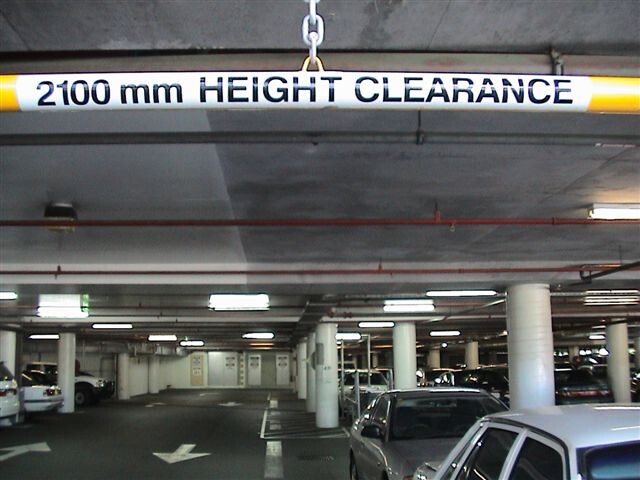
Alan Harper was right about metrication in Australia and in the United States. Thirty two years after Australia completed their metric conversion, the US has not even begun to untangle itself, if it ever does, and the Green Bay Packers still use yards. In Australia their signs are in metric:
Parking Ramp Clearance Sign in Australia — Photo by Mike Joy
If you liked this essay and wish to support the work of The Metric Maven, please visit his Patreon Page and contribute. Also purchase his books about the metric system:
The first book is titled: Our Crumbling Invisible Infrastructure. It is a succinct set of essays that explain why the absence of the metric system in the US is detrimental to our personal heath and our economy. These essays are separately available for free on my website, but the book has them all in one place in print. The book may be purchased from Amazon here.
The second book is titled The Dimensions of the Cosmos. It takes the metric prefixes from yotta to Yocto and uses each metric prefix to describe a metric world. The book has a considerable number of color images to compliment the prose. It has been receiving good reviews. I think would be a great reference for US science teachers. It has a considerable number of scientific factoids and anecdotes that I believe would be of considerable educational use. It is available from Amazon here.
The third book is not of direct importance to metric education. It is called Death By A Thousand Cuts, A Secret History of the Metric System in The United States. This monograph explains how we have been unable to legally deal with weights and measures in the United States from George Washington, to our current day. This book is also available on Amazon here.