Preferred Numbers and the “Preferred Measurement System”

Charles Renard (1847-1905)

By The Metric Maven

Bulldog Edition

In 1877 the French Engineer Charles Renard was instructed to look into improving captive balloons. These stationary, moored balloons were then in use by the French military, and of great importance. What Renard discovered was that 425 different sizes of cable were being used to moor these balloons. Clearly this large number of cables was not required from the outcome of any Engineering analysis, and were a nightmare to inventory and procure.

Renard determined that for mooring balloons, the most important inherent property of these cables, is their mass per unit length. He was able to develop a mathematical relationship which allowed him to replace the 425 sizes of cable with 17, which covered the same engineering range of requirements.

Renard’s geometric series was a perfect fit for a base 10 decimalized system, as it starts with 10 and ends with 100. The system he had in mind was of course, the metric system. This series produces what are proverbially known in engineering circles as preferred numbers (also called preferred values). Renard’s system was adopted as an international standard, ISO 3, in 1952, and are appropriately referred to as a Renard Series, or R Series. A similar series, the E series, is used to determine the values of electronic resistors, capacitors, inductors and zener diodes.

When metric was introduced into the building industry, a choice of dimensions which could easily be manipulated in one’s head was thought best. Grid lines on drawings are multiples of 100 mm. This is the basic “module” and the center to center of major dimensions are to be multiples of this value denoted as M. Therefore 3M = 300 mm, 6M = 600 mm and 12M = 1200 mm or 1.2 meters. According to Wikipedia:

For example, a multiple of 600 mm (6 M) can always be divided into 2, 3, 4, 5, 6, 8, 10, 12, 15, 20, 24, 25, 30, etc. parts, each of which is again an integral number of millimetres.

No decimals! Preferred numbers rock! Why don’t we use metric construction like the Australians again?

But not everyone is so enamored with preferred numbers and the metric system. When I was a youthful Engineer working in Aerospace, I was involved in a number of proposals for large projects. I asked, what to my fellow workers, was an incredibly naive question: “Why aren’t we bidding this in metric?” A copy of the provisional bid “boilerplate” was then shown to me. On one of the first few pages of the proposal, was a small section about metric, it read something like: “The dimensions and system of units will be of the inch-pound system. This is necessitated because of the difficulty of procuring metric fasteners in this country, and because many, many more fasteners and hardware exist and are available in inches than in metric.” I began to realize that this “boilerplate” form had been used from time immemorial as a magical talisman to vanquish any thought of using metric in Aerospace. With each new bid, it was copied like junk DNA. I’m certain a similar document is in use in Aerospace to this day, to keep metric at bay.

At that young age I was definitely naive, because I swallowed the assertion, hook, line and imperial sinker. It seemed that limiting fasteners and other hardware might keep one from creating an essential Engineering design. OMG! for want of a nail, the spacecraft might be lost!  Later I would learn from a salesman what this ploy actually was. It was FUD. In case you haven’t heard of it, this is a salesman’s term for what to do if your companies products are clearly inferior to your competitors. You must instill your customer with Fear, Uncertainty and Doubt (FUD) about the alternative product. If you use a competitors electricity, it will burn all your toast! Your soft water will come out hard! X-rays will come out of your light bulbs! The electrons will spill on the floor, and act like tiny ball bearings and you’ll slip! I hope you have health insurance! You better use Brand X electricity, or suffer the consequences!

The other option often employed to keep customers from choosing a competitor, is to create a proliferation of products who’s only purpose is to be non-interchangeable with any other competitors. I have seen this with RF/Microwave connectors. There are hundreds of them and I used to jokingly refer to each new offering as “connector of the week.” Many of them have Olde English screw threads and metric dimensions—but that is another blog. When a product is chosen by a market place “food fight” there is no guarantee that an optimal solution will be the survivor.  If one chooses a product that is not satisfactory, and is incompatible with competitors, a temptation arises to rationalize its use. “It would cost too much to switch over now, this works good enough.”  The person making the purchase does not want the bad choice to reflect on them, and will do their best to make do. Like the non-adoption of metric in the US, inculcated intellectual inertia to continue using a bad design will often prevail over reform.

The introduction of metric is a perfect opportunity (as Pat Naughtin has pointed out) to introduce much needed reform into the different trades. Pat Naughtin offers a number of examples of useful reform in his lectures, which I will not repeat here. The one example which does stand-out as perfectly in sync with the savings one can obtain by using preferred numbers, occurred in Australia. When metric was introduced into an Australian Ford car plant, the number of fasteners used by Ford were reduced by a factor of four after metric conversion. The implementation of metric threads reduced the hodgepodge of bolts by 88% and nuts by 72%. The number of sheet metal thicknesses in some factories were considerably reduced, which saved on inventory costs, and had no impact on Engineering design options. According to  Kevin Wilks in his book Metrication in Australia (thanks Klystron): When standardizing containers, Australia was able to reduce the number of can sizes, for packing goods sold by mass, from approximately 90 to 30. He goes on:

Another example in wholesale packaging concerned corrugated fiberboard cases for packing fruit. With the establishment of metric packing quantities the opportunity was taken to reduce the variety of shapes and sizes from many hundreds to about 50.

The use of preferred numbers with the metric system is good for business, despite protestations to the contrary. The metric system’s absence in the US requires consumers to pay an unseen externality penalty. Business can ignore metrication because the citizens of the US pick up the tab, but don’t realize it. This unseen cost to consumers exists because of an inefficient measurement system, which powerful segments of the business lobby in the US, have perennially refused to allow government to legislate out of existence, since at least 1921. The cost of extra waste and inefficiency is just passed on to the consumer.

These costs also make American industry more expensive when compared with overseas companies. We need mandatory metrication, and we need it now to reform America, and make it competitive in the 21st Century—before the 22nd arrives.


If you liked this essay and wish to support the work of The Metric Maven, please visit his Patreon Page and contribute. Also purchase his books about the metric system:

The first book is titled: Our Crumbling Invisible Infrastructure. It is a succinct set of essays  that explain why the absence of the metric system in the US is detrimental to our personal heath and our economy. These essays are separately available for free on my website,  but the book has them all in one place in print. The book may be purchased from Amazon here.


The second book is titled The Dimensions of the Cosmos. It takes the metric prefixes from yotta to Yocto and uses each metric prefix to describe a metric world. The book has a considerable number of color images to compliment the prose. It has been receiving good reviews. I think would be a great reference for US science teachers. It has a considerable number of scientific factoids and anecdotes that I believe would be of considerable educational use. It is available from Amazon here.


The third book is not of direct importance to metric education. It is called Death By A Thousand Cuts, A Secret History of the Metric System in The United States. This monograph explains how we have been unable to legally deal with weights and measures in the United States from George Washington, to our current day. This book is also available on Amazon here.

MetricBusters

MetricBusters

By The Metric Maven

Bulldog Edition

It is the best of shows, it is the worst of shows. It is a show that attempts to show the nuts and bolts use of scientific thinking when deciding propositions. It is also a show that promotes the worst of American disorganization and lack of planning. Yes, I said this about MythBusters. You can stop gasping now. It is a show that indicates it’s about Science! and claim they are “experts,” so don’t try this at home kids!  But they also have warnings about “Science Content” lest too much science depress their ratings. Four years ago on 2008-10-30 I wrote to the MythBusters as a Professional Engineer, another kind of “expert,” who is not on television. I pleaded with them to adopt metric only in their show,  and to encourage metric thinking. The US Mail and email I sent to these prominent “Technical Personalities”  was met with nothing but silence. Their lack of concern for metric seems to say “we’re all for science, but we just don’t care about organized measurement.”  I discovered that MythBusters  fan boards have inquired about their lack of  exclusive metric use from at least as early as 2006.  There has been nothing but The Silence of the MythBusters concerning metric for at least the last six years. But on 2012-09-30, during a Reddit Driven Q&A session, a metric advocate asked Adam Savage the question directly:

Q: Why don’t you guys use the Metric System on Mythbusters? as it is the standard for scientific experimentation

By: KyleGustafson

A: We try, we do both sometimes. But we’re both fully inculcated with the english system, sad to say. That’s how we think.

Wow, that’s it? That’s all that Adam has to say? He has been so inculcated with the Olde English non-system by our culture, that he cannot think otherwise? A MythBuster can’t think otherwise! His mind embraces disorganization and rejects organization, and nothing can be done? This is MythBusters! A show that is supposed to challenge myths, and change peoples views. But when it comes to embracing metric, all Adam has to say is “we try.”  Adam, seriously, it sounds like an excuse which is as lame as: “the dog ate my homework.” Apparently you just don’t give a damn Adam, and don’t care to. As Jamie is silent, I can only assume the same. Your show is completely counter-factual to your anemic assertion that “we try” when it comes to metric. It appears that the use of measurement units in Mythbusters is at best thoughtlessly ad hoc, and at worst, willfully ignorant. How feckless. You and Jamie find the courage to have a bridge drop out from under you while you dangle in the air 50-75 meters above concrete below, but the metric system is too scary?—too much of a challenge?

Why am I so upset about this show? Why do I care?—after all it’s just one more program emanating from “the vast wasteland.” I care because I’m very certain that scores of young American children are inspired to consider Engineering or Science as vocations because of this program. The unfortunate fact is that MythBusters propagates the inculcation of the American hodgepodge of pigfish measuring units on television. This will acclimate another generation of aspiring Engineers and Scientists into accepting the US measurement status-quo. Because of this learned comfort for a farrago of mixed measurement units is being inculcated into another generation of youth, metric will not move forward a millimeter in the US for at least another generation.

I’m an enthusiastic fan of the show’s premise, but find the execution of it by the Mythbusters cohort to be at best amateur, and at worst ignorant, when measurement units are involved. MythBusters seems to encourage an attitude of “just make it up as you go kids!—grams and inches—milliliters and ounces—no problem, don’t worry about it—–we’re doing science!”

Adam appears to be fishing for some manner of absolution by saying:: “we do both [English and metric units] sometimes.”  Why how “fair and balanced” of you. Adam, seriously, take time from being feted, and read Naughtin’s 1st Law: Dual Scale Instruments are Evil. The rest of Naughtin’s Laws are here, but I suggest you don’t take my website’s word for it, how about watching one of his lectures about metric? You will also hear his “don’t dual with dual” assertion. Perhaps you might even check out his Metrication Matters website and learn a bit about the system your show ignores and 95% of the world uses.

The story behind the creation of MythBusters is curious. Here is what Wikipedia has to say in it’s first sentence:

MythBusters is a science entertainment TV program created and produced by Australia’s Beyond Television Productions[1] for the Discovery Channel. The series is screened by numerous international broadcasters, including SBS Australia, 7mate Australia, and other Discovery channels worldwide

The entry continues: “Filming is based in San Francisco, though some elements of production are done in Artarmon, Australia.”

So MythBusters was proposed and created by an Australian Television Company!  Australia is the one English speaking country where metric is ubiquitous. Houses in Australia are all built in  millimeters and meters only. The Land of Oz is where one can purchase 300 mm, 600 mm, and 1000 mm metric only rulers (and tape measures) at the Land Down Under’s local equivalent of The Home Depot. You can be certain you’re not in Kansas anymore when that happens. You order your steaks in grams there.  Kilojoules are what one counts when on a diet in Oz, and not Calories (1000 calories = 1 Calorie). Was there not one discussion of exclusively using metric units in MythBusters by its Australian creators?! Inquiring Metric Mavens want to know.

Since 2003, the MythBusters have used measurement units with a contempt that is so reckless, that I suspect it is born of complete ignorance. I will give you one example, but choose almost any episode where multiple measurement units occur, and you will get showered with a farrago of Furlongs per Fortnight measurement units and metric mixed in without distinction.

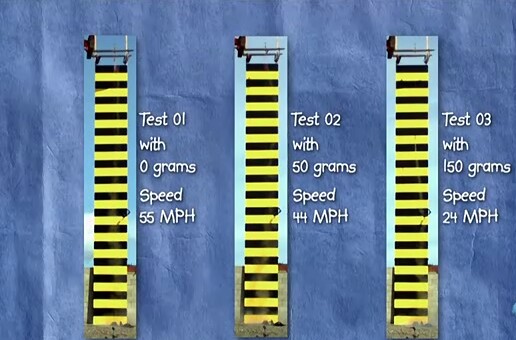
In one program segment entitled   Fireworks Man,  Grant, Tory and Kari need to measure how much known weights will decrease the speed of a commercially available fireworks rocket. They set up a yellow and black 32 foot scale, in one foot increments, against which they photograph the rockets to determine their speed. They compute the speed of an unloaded rocket as 80 feet per second, then convert it to 55 miles per hour.

This triumvirate of technology next add nuts, which each weigh 50 grams, to reduce the rocket speed. They determine the optimum load (50% reduction in speed) is 150 grams. Grant then states: “Well with 400 rockets, 150 grams that’s 60 kilograms. That’s a carrying capacity of about a 130 pounds.” Feet, miles, grams, kilograms, pounds. The rockets were not powerful enough for 400 of them to possibly lift a man.

The myth is supposedly German in origin, which leads Kari, Tory and Grant to discover that commercially available European fireworks have more thrust than their American counterparts. The European rockets can carry 300 grams per rocket. The graphics for all the tests show the results in miles per hour against weight in grams.

In the full scale test, black powder is used to produce a synchronous ignition of the rocket engines. As Tory is pouring in the black powder He says: “Now I know this might not seem like a lot of black powder, but I’m actually using six ounces, I mean that would be plenty to fire off a cannon ball.” The MythBusters segment has now used feet, miles, grams, kilograms, pounds, and ounces (by weight not volume I assume?).

According to Wikipedia, when the MythBusters show is shown in some countries:

The United States customary units, used by the hosts throughout the show, are converted to metric in the process. Sometimes, the part where the myth is explained in sketches is completely redrawn in that language.

Seriously, is America ever going to grow up and face up to the importance of metrication? Apparently Adam’s cavalier attitude verifies to me that we need mandatory metric legislation to change our schools, industry and government to metric. Otherwise Adam Savage’s descendants will also be prisoners of “english system” inculcation. The MetricBusters have become so celebrated, they are now Dr. Adam Savage and Dr. Jamie Hynaman. According to Wikipedia:

Hyneman and Savage received honorary doctorates from the University of Twente in the Netherlands for their role in popularizing science, on the occasion of the university’s 50th anniversary, on November 25, 2011.[65]

Right through The Metric Maven’s heart! The country which has used metric the longest, awarded them Doctorates.

Well, add another 100 years before metric is possible in this country. You can thank Adam and Jamie, The MetricBusters, for doing their part. With friends like them, who needs reactionaries?


If you liked this essay and wish to support the work of The Metric Maven, please visit his Patreon Page and contribute. Also purchase his books about the metric system:

The first book is titled: Our Crumbling Invisible Infrastructure. It is a succinct set of essays  that explain why the absence of the metric system in the US is detrimental to our personal heath and our economy. These essays are separately available for free on my website,  but the book has them all in one place in print. The book may be purchased from Amazon here.


The second book is titled The Dimensions of the Cosmos. It takes the metric prefixes from yotta to Yocto and uses each metric prefix to describe a metric world. The book has a considerable number of color images to compliment the prose. It has been receiving good reviews. I think would be a great reference for US science teachers. It has a considerable number of scientific factoids and anecdotes that I believe would be of considerable educational use. It is available from Amazon here.


The third book is not of direct importance to metric education. It is called Death By A Thousand Cuts, A Secret History of the Metric System in The United States. This monograph explains how we have been unable to legally deal with weights and measures in the United States from George Washington, to our current day. This book is also available on Amazon here.